
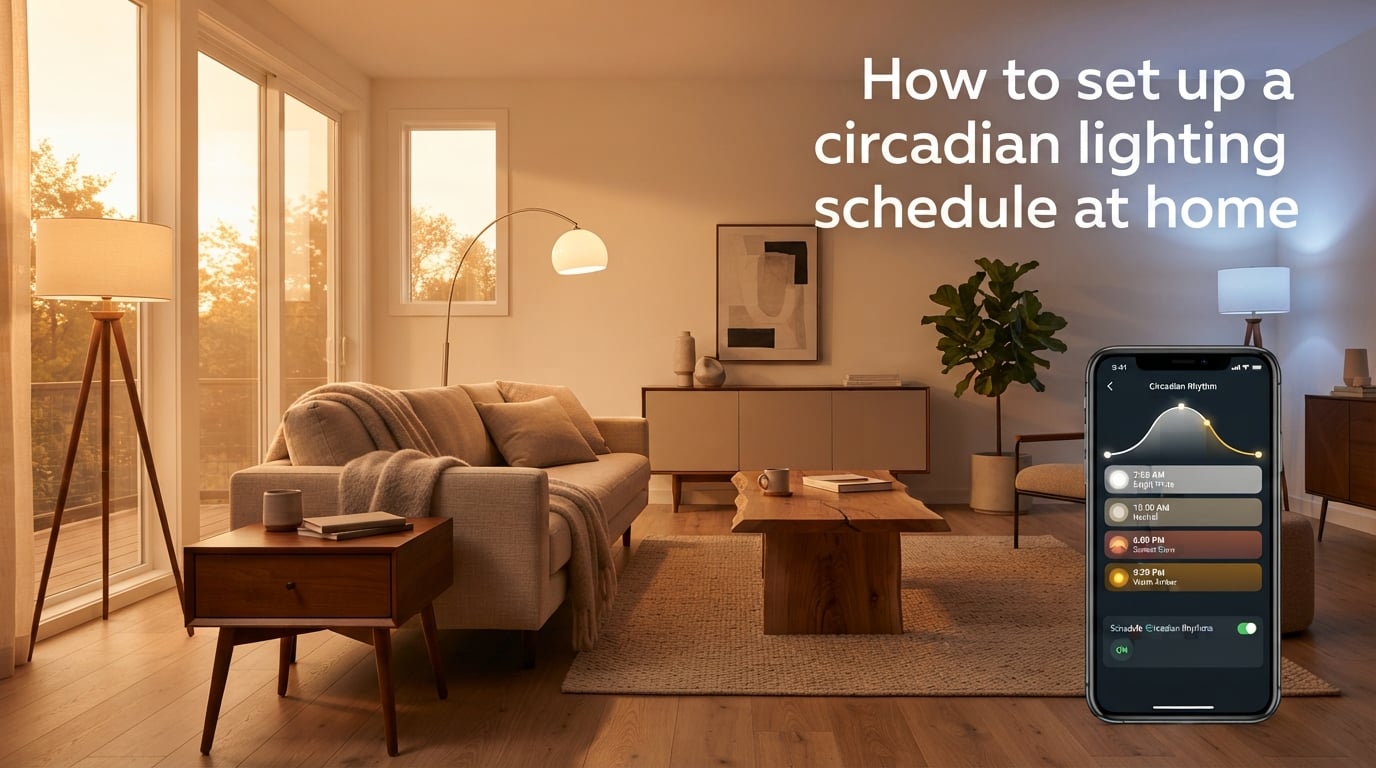
I used to fall asleep with the TV on and wake up to a pitch-black room, wondering why my energy crashed at 2 p.m. every day. The fix turned out to be simpler than I expected: I rebuilt my home lighting around my body’s natural rhythm. In this guide, I’ll show you exactly how to set up a circadian lighting schedule at home so you can sleep deeper, wake up sharper, and feel more steady through the day.
A circadian lighting schedule is a system that changes your light’s color temperature and brightness across the day to mirror natural sunlight. Cool, bright light in the morning tells your brain it’s time to be alert. Warm, dim light in the evening tells your body it’s time to wind down. When you program that pattern into your lights, you stop fighting your biology and start working with it.
By the end of this article, you’ll have a clear plan: what to buy, how to install it, what color temperature to use at each hour, and how to avoid the mistakes I made on my first try.
Table of Contents
- What Is Circadian Lighting?
- How Circadian Lighting Works (The Science)?
- Benefits of Following a Circadian Lighting Schedule
- What You Need to Get Started?
- Step-by-Step Guide: How to Set Up a Circadian Lighting Schedule at Home
- Recommended Color Temperature Schedule
- Room-by-Room Circadian Lighting Tips
- Common Mistakes and Troubleshooting
- Frequently Asked Questions
- Conclusion
What Is Circadian Lighting?
Circadian lighting is a lighting strategy that adjusts both color temperature and brightness throughout the day to support your circadian rhythm, the 24-hour internal clock that controls sleep, alertness, hormone release, and mood. Rather than using one static light setting, the system shifts from cool, bluish-white light in the morning to warm, amber light in the evening.
This isn’t the same as a regular color-changing bulb that cycles through rainbow presets. True circadian lighting follows the actual arc of the sun. The aim is to reproduce outdoor light cues indoors, especially for people who work from home, live in darker climates, or spend most of their day under artificial light.
The concept rests on a simple idea: light is a signal. Your eyes contain special photoreceptor cells (called intrinsically photosensitive retinal ganglion cells, or ipRGCs) that send timing information straight to the part of your brain that runs your body clock. When that signal matches the actual time of day, everything from melatonin to digestion stays in rhythm.
How Circadian Lighting Works (The Science)?
The science behind circadian lighting is surprisingly direct. Light enters your eye and hits those ipRGCs, which then talk to your suprachiasmatic nucleus, the master clock in your brain. From there, signals fan out to regulate melatonin (the sleep hormone), cortisol (the wake-up hormone), body temperature, and alertness.
Two properties of light drive this signal more than any others: intensity (measured in lux) and color temperature (measured in Kelvin). Cool light around 5000K to 6500K suppresses melatonin and boosts alertness, which is why a sunny day makes you feel awake. Warm light around 2200K to 2700K does the opposite, encouraging melatonin production and signaling that it’s time to sleep.
The Kelvin scale describes how warm or cool a light looks. Lower Kelvin numbers (1800K to 3000K) look amber or yellowish, like candlelight or sunset. Higher Kelvin numbers (5000K to 6500K) look bluish-white, like midday sun. Most standard LED bulbs ship at 2700K, which is fine for evenings but not for mornings.
Brightness matters just as much as color. Studies show that getting 30 minutes of bright light (around 1000 lux or more) soon after waking helps shift your body clock earlier and improves daytime alertness. In the evening, dropping brightness to under 100 lux in living areas is a strong cue for your brain to start producing melatonin.
For the technical cluster worth remembering: CCT (Correlated Color Temperature) is the formal name for Kelvin, CRI (Color Rendering Index) measures how natural colors look under a light, and lux measures how much light hits a surface. You don’t need to memorize these, but they show up on every smart bulb spec sheet.
Benefits of Following a Circadian Lighting Schedule
People who run their home lighting on a circadian schedule report four main benefits: better sleep, steadier daytime energy, improved mood, and easier adjustment to seasonal changes.
Sleep improves because your melatonin production lines up with the actual time of day. When you dim and warm your lights two to three hours before bed, your brain gets a clean wind-down signal. A 2023 systematic review in the Journal of Clinical Sleep Medicine found that warm, dim evening lighting reduced the time it took to fall asleep by an average of 11 minutes compared to bright cool light.
Daytime energy gets a boost from morning bright light exposure. One of the simplest tricks I recommend is opening blinds for 10 to 20 minutes right after waking. If your home office faces east, even better. The bright light helps release cortisol at the right time, which sharpens focus for the first half of your workday.
Mood and seasonal adjustment are big wins for people who deal with low-energy winters. Light therapy boxes have used this principle for decades, but a whole-home circadian system gives you that benefit across every room, not just where the box sits.
Productivity in the home office improves because cool light during work hours keeps you alert without the jittery feeling of extra caffeine. When I switched my desk lamp to 5000K at 9 a.m. and dialed it back to 3000K by 6 p.m., I stopped hitting the 3 p.m. energy wall within the first week.
Eye strain decreases too. Bright, properly lit environments reduce the squinting and screen-fatigue you get from working in a dim room with a glowing monitor.
What You Need to Get Started?
Here’s the shopping list I walk my friends through when they want to set up a circadian lighting schedule at home. You don’t need every item, but this is the full picture.
Adjustable white LED bulbs are the foundation. You want bulbs that can change both color temperature (CCT) and brightness. Look for “tunable white” or “adjustable white” bulbs, not just dimmable ones. Brands like Philips Hue, LIFX, Wyze, and Govee all make solid options. Most use Zigbee, Wi-Fi, or Bluetooth.
A smart home hub or app connects everything. The simplest path is to buy bulbs that pair directly with your phone over Wi-Fi or Bluetooth. If you want more control or have a mix of brands, a hub like Philips Hue Bridge, SmartThings, or a Home Assistant green box unlocks advanced scheduling.
Smart switches are an alternative to smart bulbs. If your home has many fixtures or recessed lights that take hard-to-find bulbs, a smart dimmer switch (like Lutron Caseta or GE Cync) can control anything wired to it. The trade-off is that smart switches don’t change color temperature on their own, so you lose the warm-to-cool effect.
Voice assistants like Alexa, Google Assistant, or Apple HomeKit add convenience for manual overrides. You can say “dim the living room to 30%” without pulling out your phone.
A backup option if you don’t want any smart tech: warm-white bulbs (2200K to 2700K) for evening rooms and cool-white bulbs (4000K to 5000K) for morning and work rooms. You switch them manually. It’s old-school but still effective.
Step-by-Step Guide: How to Set Up a Circadian Lighting Schedule at Home
Follow these steps in order. Most people can finish the full setup in under two hours.
Step 1: Pick the rooms that matter most
Start with two or three rooms: your bedroom, home office, and main living area. Bathrooms and kitchens are nice to add later. Don’t try to convert every fixture in your home on day one, or you’ll burn out.
Step 2: Map your day to light zones
Write down your typical day: wake time, work hours, dinner, wind-down, and bedtime. Each block needs a different color temperature target. I’ll give you the exact schedule later in this guide.
Step 3: Replace the priority bulbs
Swap out the bulbs in your chosen rooms with tunable white smart bulbs. Keep the boxes and receipts in case you want to add more later. Most smart bulbs screw into standard sockets, so this step is genuinely just unscrew and screw.
Step 4: Connect bulbs to your platform
Download the app that matches your bulbs. For Philips Hue, install the Hue app and pair the bridge. For Wi-Fi bulbs, scan the QR code on the bulb or add it through the app’s device menu. For Home Assistant, install the official integrations.
Step 5: Create a routine in your app
This is where the schedule lives. In the Philips Hue app, open Routines and pick “Sunrise” or “Custom.” In Home Assistant, use the Adaptive Lighting custom component or a circadian blueprint. In SmartThings, set up Automations with time triggers.
Set these four anchor points for each day:
Wake time: 100% brightness, 5000K to 6500K (cool, blue-white)
Midday: 100% brightness, 4500K to 5000K (clean white)
Late afternoon: 80% brightness, 3000K to 3500K (warm white)
Evening: 30% to 50% brightness, 2200K to 2700K (amber)
Step 6: Add transitions, not jumps
Don’t snap from one setting to the next. Set each transition to take 15 to 30 minutes. A gradual shift mimics the real sky and feels much more natural. Most smart apps let you set a transition duration in seconds.
Step 7: Test and refine for one week
Run the schedule for seven days before making changes. Notice when you feel sleepy, when you feel alert, and whether the kitchen is too dim at dinner. Adjust only after a full week so your body has time to adapt.
Step 8: Layer in manual overrides
Add a “Focus” or “Work” scene that snaps to 5000K at 100% for high-concentration tasks. Add a “Movie” scene at 2200K at 20% for film nights. Manual scenes don’t break the automated schedule; they just temporarily override it until the next scheduled change.
Recommended Color Temperature Schedule
Here’s the daily color temperature schedule I use in my own home. Treat the times as a starting point and shift them to match your actual wake and sleep times.
| Time of Day | Color Temperature (Kelvin) | Brightness | Purpose |
|---|---|---|---|
| 5:00 a.m. to 7:00 a.m. | 2200K to 2700K | 10% to 30% | Pre-dawn amber, gentle wake-up if you rise early |
| 7:00 a.m. to 9:00 a.m. | 5000K to 6500K | 90% to 100% | Morning boost, suppress melatonin, raise alertness |
| 9:00 a.m. to 12:00 p.m. | 4500K to 5000K | 100% | Midday focus, work and concentration |
| 12:00 p.m. to 4:00 p.m. | 4000K to 4500K | 90% to 100% | Afternoon steady state, balanced light |
| 4:00 p.m. to 7:00 p.m. | 3000K to 3500K | 70% to 90% | Late afternoon, gradual shift toward warm |
| 7:00 p.m. to 9:30 p.m. | 2200K to 2700K | 40% to 60% | Evening wind-down, dimmer warmer light |
| 9:30 p.m. to 11:00 p.m. | 1800K to 2200K | 10% to 30% | Bedtime preparation, candle-like glow |
| 11:00 p.m. to 5:00 a.m. | Off or nightlight | 0% to 5% | Sleep, only motion lights if needed |
If you live in a darker climate or work night shifts, the schedule needs tweaks. Shift workers should flip the entire chart: cool light during their active hours and warm dim light when they need to sleep during the day.
Room-by-Room Circadian Lighting Tips
Different rooms serve different functions, so your circadian lighting schedule should treat each one as its own zone. Here’s how I break it down.
Bedroom
The bedroom is where circadian lighting pays off the most. Use a sunrise alarm bulb or smart bulb that fades up from 0% at your wake time over 15 to 30 minutes. This is far gentler than a sudden alarm and has been shown to reduce morning grogginess. In the evening, drop to 1800K by 9 p.m. and turn the main lights off entirely 30 minutes before you plan to sleep.
Home Office
Your home office should hit 5000K at 100% brightness by 9 a.m. and stay there through the bulk of your work hours. Cool light keeps you alert and reduces the urge to keep grabbing caffeine. Switch to 3000K by 6 p.m. to signal that work is done. Add a desk lamp with its own tunable bulb so you can adjust independently of overhead lights.
Kitchen
Kitchens need bright light for safety during cooking. Aim for 4000K at 80% to 100% during meal prep and dinner. After dinner, drop to 2700K at 40% so the kitchen doesn’t blast light into the rest of your evening.
Living Room
The living room is your transition zone. Match it to whatever activity is happening: movie nights at 2200K and 20%, reading at 3000K and 60%, game nights at 3500K and 70%. A good smart app lets you save these as scenes and switch with a single tap.
Bathroom
Bathrooms benefit from motion-triggered nightlights set to 1800K. The harsh overhead light at 2 a.m. is the enemy of sleep, so a soft warm glow under 5% works better when you stumble in for water.
Common Mistakes and Troubleshooting
Even with a good plan, a few issues pop up again and again. Here’s what to watch for and how to fix it.
Mistake 1: Using only color-changing bulbs without scheduling. If your bulbs can change color but you never automate them, you’re not running circadian lighting. You’re just running RGB bulbs. Schedule is what makes the system work.
Mistake 2: Skipping morning bright light. Most people focus on the wind-down side and forget the wake-up side. Without strong morning light, the evening dimming has less effect. Get bright cool light into your eyes within an hour of waking.
Mistake 3: Smart switch and smart bulb conflicts. If you install smart bulbs but your family keeps flipping the wall switch off, the bulbs lose power and your schedule breaks. Either replace the switch with a smart one set to always-on, or use smart bulbs with a remote that doesn’t need the wall switch.
Mistake 4: Setting brightness too low for daytime. A circadian schedule means dialing back brightness in the evening, not all day long. If your office is dim at 11 a.m., you’ve gone too far. Bright daytime light is the whole point.
Mistake 5: Expecting instant results. Your body needs five to seven days to adjust to a new light pattern. Don’t abandon the schedule after two days because you still feel tired.
Troubleshooting tip: If a bulb drops off the network, check the wall switch first. Nine times out of ten, someone turned it off manually. The second most common cause is Wi-Fi congestion; move your hub closer to the bulb or add a Zigbee repeater.
Budget tip: If smart bulbs feel expensive, start with one tunable bulb in your bedside lamp and one in your desk lamp. Two bulbs cover your most important sleep and work hours for under $50 total.
Frequently Asked Questions
How to set up circadian lighting?
Start with two or three tunable white smart bulbs in the rooms where you spend the most time. Connect them to an app that supports scheduling, then program four anchor points across the day: cool bright light in the morning, neutral white at midday, warm light in the late afternoon, and dim amber in the evening. Use 15 to 30 minute transitions between each phase so the change feels natural.
What is the ideal circadian rhythm schedule?
A practical schedule runs from 5000K to 6500K at full brightness in the morning, shifts to 4500K at midday, drops to 3000K in the late afternoon, and finishes at 2200K at 30 to 50 percent brightness in the evening. Move all transitions by 15 to 30 minutes so your eyes and brain adjust gradually. Adjust the times to your own wake and sleep window.
What color light is best for circadian rhythm?
Cool, blue-rich white light around 5000K to 6500K is best for mornings and active hours because it suppresses melatonin and supports alertness. Warm, amber light around 2200K to 2700K is best for evenings because it allows melatonin to rise and signals the body to wind down.
Do circadian rhythm lights work?
Yes, the research on timed light exposure is solid. Studies show that bright light in the morning and dim warm light in the evening improve sleep onset, sleep quality, and daytime alertness. The effect is strongest when the schedule is consistent across multiple rooms rather than limited to a single lamp.
How much morning sunlight do you need to reset your circadian rhythm?
Around 10 to 30 minutes of outdoor light within the first hour of waking is enough to give your circadian rhythm a strong reset signal. Aim for 1000 lux or more, which you can usually get from a sunny window or a brief walk outside. On cloudy days, sit by the brightest window you have for 20 to 30 minutes.
Conclusion
Setting up a circadian lighting schedule at home comes down to three core moves: pick the right tunable bulbs, program a four-phase daily schedule from cool morning to warm evening, and run the system for at least a week before judging the results. Once you have it dialed in, your lights do the work for you, dimming before bed and brightening after wake without any taps or commands.
Start small with two or three bulbs in the rooms that matter most, and expand as you get comfortable. Your sleep, focus, and mood are all downstream of the light signal your body receives, so this single change tends to pay back far more than it costs in time and money.